
How Bench Warrants Work in McMullen County
A bench warrant is a judge's order, usually after a missed setting, contempt, or an unmet court condition. McMullen County's own County Court reset form says "capias (warrant)" in its warning. That label is everyday wording. It does not create a county bench-warrant policy or a public lookup. So where does the order come from? McMullen County runs three shared District Courts for felony, family, civil, and juvenile cases, plus a County Court misdemeanor docket and one countywide JP court. The first question is which court set the matter. A clerk or administrator can route the case to its division. The sheriff, for its part, can say whether that office holds or serves an order. Each office answers a different half of the question.
McMullen County Bench Warrant Courts
The 36th, 156th, and 343rd Judicial District Courts serve McMullen County alongside four other counties. Each court keeps its own administrator. A missed felony setting may therefore take more than a call to the Tilden courthouse line. The combined County/District Clerk can still help you identify the court division and the file. Start with the court number on your notice if you have one. County Court runs the local misdemeanor docket. Its page links court dates and a reset request. The JP court, countywide rather than four precinct courts, handles traffic-citation questions. These routes matter in practice. A sheriff contact in McMullen County may know execution status. Only the issuing court can explain a reset, a recall, or the hearing it requires.
District Court Administrators
36th: 361-318-0304
156th and 343rd: 361-364-9310
Bench Warrant Issuance in McMullen County
Skip a court setting in McMullen County and further process can follow. So can an unapproved reset, a bond violation, contempt, or an unpaid judgment. The exact order depends on the case and the court. The McMullen County reset form asks for the case/cause number and the reason for the request, and it carries a plain warning: inaccurate information may cause a failure to appear, bond revocation, or a capias. Nothing is final until the court approves the request. A reset is also not a motion to recall. The county site publishes a reset or continuance route, not a form promising warrant relief. If a setting has passed, call the court. Ask whether process issued and what remedy applies. County Court reset request and instructions
McMullen County Warrant Reset Limits
The McMullen County reset form is a request for a new court setting. It is due no later than the Friday before the date. The court still has to approve it. A defendant with an attorney must have the attorney submit the request. Nothing on the page promises that filing recalls an existing capias or prevents an arrest. A form receipt is not a court order. For a missed County Court setting, use the county's misdemeanor docket and reset information, then ask a clerk what status shows on the case. For a District Court case, contact the assigned administrator directly. Ask which step, whether an appearance, a hearing, bond, or a court order, will update the warrant record in McMullen County.
Do not treat a submitted reset request as approval or as a recall; ask the issuing court to confirm the result.
How Bench and Arrest Warrants Differ
Both kinds can authorize an arrest. They simply start at different points. An arrest warrant follows probable-cause review for an alleged offense. A bench warrant usually ties to a missed setting or a court obligation already in place. Texas adds its own vocabulary: a capias orders a defendant brought before the court, while a capias pro fine concerns a fine, costs, or contempt after judgment. McMullen County courts use these labels, so learn which one applies to you.
| Process | Common trigger | First office to ask |
|---|---|---|
| Arrest warrant | Complaint and probable cause | Issuing court or magistrate |
| Bench / FTA | Missed setting or noncompliance | Court that set the case |
| Capias pro fine | Post-judgment fine or contempt | Court that entered judgment |
Ask the clerk for the exact label on your McMullen County case. Public pages may say "capias" while you think of the matter as a bench warrant.
Capias Pro Fine Has Safeguards
Texas law spells out the capias pro fine process. District and county courts operate under Chapter 43, and lower courts under Chapter 45A. The statutes provide an undue-hardship hearing process. They also provide a path to recall, available when a person gives notice for a hearing or voluntarily appears and makes a good-faith effort to resolve the matter. The local court must tell you which procedure applies and how to file. McMullen County publishes no local capias-pro-fine form, bond amount, payment plan, or counter hours. So ask directly. Keep two limits in mind. A payment does not prove the warrant was recalled. And a recall does not dismiss the underlying case. Request written confirmation and the next setting. The Texas Code of Criminal Procedure, Chapter 43 sets out the court process these routes follow in McMullen County and statewide.
Chapter 43 governs capias in district and county courts. The current Texas Chapter 45A governs the justice and municipal court process that covers McMullen County's JP court.
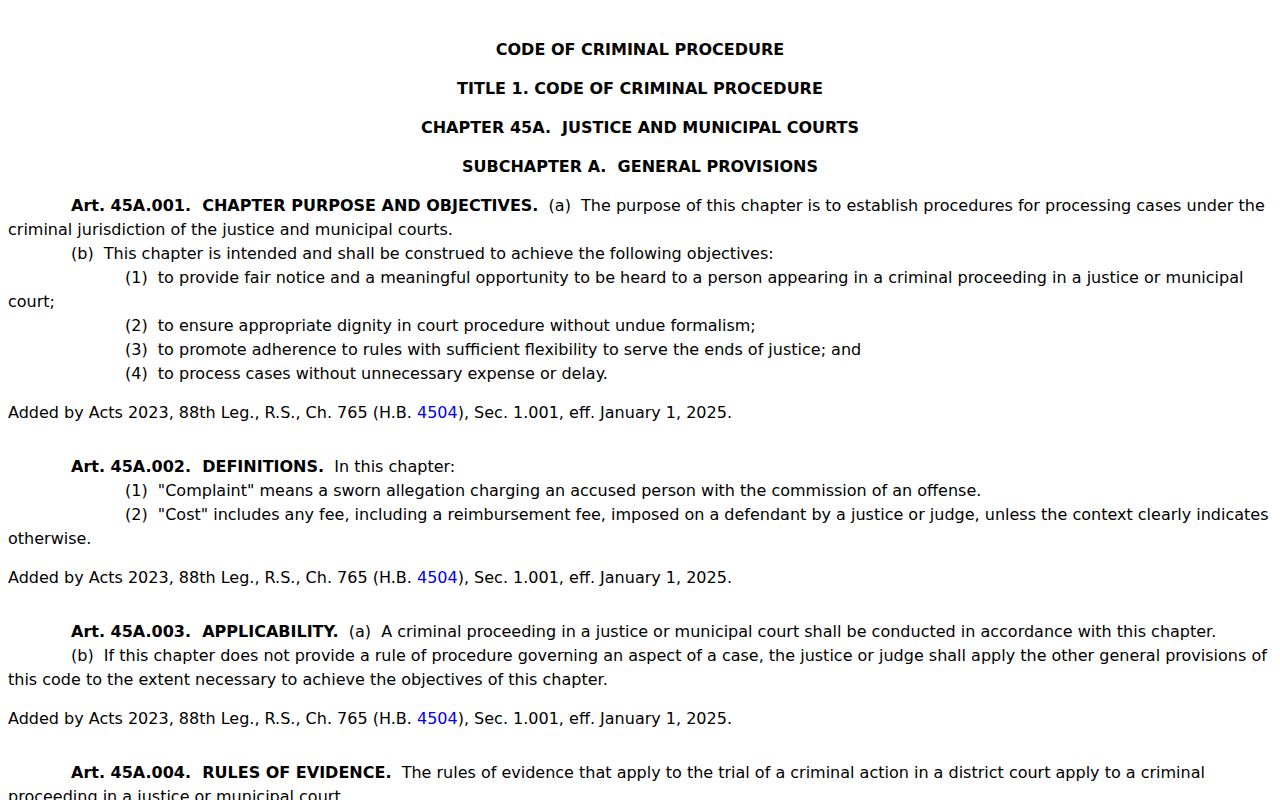
Chapter 45A supplies the lower-court framework relevant to JP citation matters.
Clearing a Bench Warrant in McMullen County
Start with the cause number and the court that issued the order. The clerk or court administrator can tell you whether the case shows an FTA, a capias, a bond revocation, or something else entirely. Ask what the court expects next. That may be a reset request, a voluntary appearance, bond reinstatement, a hearing, or a motion. If a bond is required, confirm where the court accepts it and which forms of payment or surety it allows. McMullen County publishes no county bond window and no bond schedule.
Next step: Call the issuing clerk before paying or appearing, and ask what exact action will change the status.
McMullen County Courts That Issue Bench Warrants
A traffic matter belongs to the countywide JP clerk. That office sits at 504 Courthouse Drive in Tilden, and the phone is 361-274-3372. Email works too: jpclerks@mcmullencounty.org. Phones are answered through 1 p.m., while in-person hours run to 4 p.m. The JP page asks callers to speak with a clerk rather than contact the judge directly about a citation. County Court questions go to 501 River Street or 361-274-3900, and the combined County/District Clerk is listed at 361-274-3215. The 2nd Multi-County Court at Law sits in George West, so confirm a case is assigned there before using its administrator contacts. McMullen County has no separate Tilden municipal court.
McMullen County JP Clerk
504 Courthouse Drive, Tilden, TX 78072
361-274-3372
Voluntary Appearance Questions
Ask before you drive anywhere. Find out which location handles the order, whether an attorney should arrange a walk-through, and what identification to bring. Also ask whether bond can be set before you appear and how the court records a recall or service. McMullen County publishes no surrender hours, and calling will not guarantee an arrest is prevented. Note the sheriff's address is an office address, not a jail intake or bond counter.
- Confirm the court and case/cause number.
- Ask the clerk what procedure changes the warrant status.
- Get current bond, appearance, and document instructions.
- After court action, ask when the sheriff receives the update and whether a new setting remains.
Write down the call date and the office's direction. If a relative calls for a defendant in McMullen County, get the defendant's permission first.
Family Cases Need the Right Clerk
Family and juvenile matters run through the McMullen County District Courts, alongside felony cases. A family-related order may follow a different access rule than an ordinary adult arrest warrant. Texas Family Code §58.010 keeps a juvenile arrest warrant, with its complaint or affidavit, confidential. Only limited legal access applies. So a quiet search result proves nothing about whether an order exists. For a case-specific question, contact the District Clerk or the court administrator and ask how to request information lawfully. McMullen County has no public warrant roster to search, and staff may not release a protected record to an unauthorized caller. If court action may be needed, consult a licensed Texas attorney.